
Advocacy Toolkit: Make the Case for Languages in Mississippi
Programs don’t close because teachers stop caring. They close because nobody made the case for keeping them. This toolkit gives you the numbers, research, and next steps to make that case to your principal, your school board, or your legislators.
Every figure below links to its original source, so you can check it, cite it, and share it with confidence.
Effective advocacy has three parts: evidence (the numbers on this page), a story (a real student or family), and an ask (one specific action your listener can take).
Mississippi at a Glance
Our economy already works in other languages
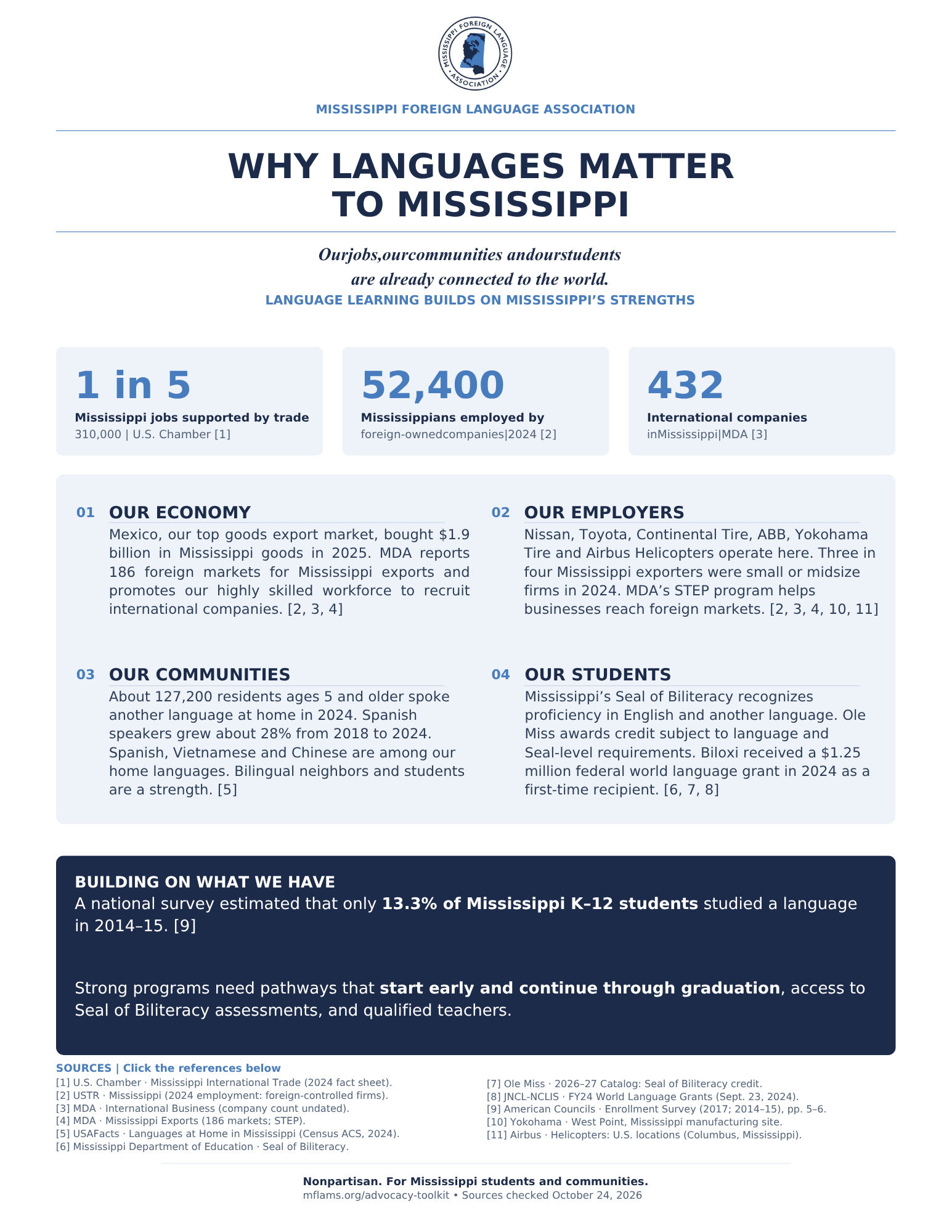
1 in 5 Mississippi jobs (310,000) are supported by trade. (U.S. Chamber of Commerce, 2024)
52,400 Mississippians are employed by foreign-owned companies such as Toyota, Nissan and Airbus. (U.S. Trade Representative, 2024 data)
432 international companies operate in Mississippi, and the state recruits them by promoting its highly skilled workforce. (Mississippi Development Authority)
Mexico is our No. 1 export market ($1.9 billion in 2025), followed by Panama and Canada. Mississippi businesses sell to 186 foreign markets. (U.S. Trade Representative; Mississippi Development Authority)
Three in four Mississippi exporters are small or midsize firms, and the state’s STEP program helps them reach foreign markets. (U.S. Trade Representative; Mississippi Development Authority)
Global companies that call Mississippi home
Nissan in Canton (Mississippi Free Press), Toyota in Blue Springs (Mississippi Business Journal), Continental Tire and ABB (Mississippi Development Authority), Yokohama Tire in West Point (Yokohama), Airbus Helicopters in Columbus (Commercial Dispatch), and Grammer in Tupelo (Trade & Industry Development). About 50 Japanese companies alone employ nearly 15,000 Mississippians. (Consulate General of Japan)
Our communities are multilingual
127,200 Mississippians speak a language other than English at home, and Spanish speakers grew 28% from 2018 to 2024. (USAFacts, Census data)
About 14,000 English learners attend Mississippi public schools, up from 0.4% of students in 2000 to 3.1% today. (Mississippi First, 2023)
But too few students are learning languages
Only 13.3% of Mississippi K-12 students were enrolled in a language class, ranking 38th of 51. This 2017 figure is the most recent state-level data available. (American Councils, 2017)
Advocacy wins
The Mississippi Seal of Biliteracy recognizes graduates who reach proficiency in English and another language, and Ole Miss awards credit for it. (Mississippi Department of Education)
Biloxi Public Schools received $1.25 million in federal World Language Advancement and Readiness (WLARA) funding in 2024 as a first-time recipient. (JNCL-NCLIS)
National Research
What employers say
9 in 10 U.S. employers rely on employees with skills in a language other than English, and 85% of them need Spanish. (ACTFL, Making Languages Our Business)
41% of companies say they missed international opportunities because they lacked internationally skilled staff, up from 30% in 2003. 84% will place more emphasis on international competence over the next ten years. (AIBER, US Business Needs for Employees with International Expertise, 2025)
What schools offer
Only 20% of U.S. public elementary schools offer a world language. 42.5% of schools found language teacher vacancies very hard or impossible to fill. Graduates average 2.2 years of language study, unchanged since 2009. (ACTFL, The State of K-12 World Language Education, 2026)
Take Action
Choose one of these this month. Small and local counts.
Invite a decision-maker. Ask your principal or a school board member to watch your students use the language.
Share one number. Send a Seal of Biliteracy count, an enrollment figure, or a statistic from this page to someone who makes decisions.
Join MFLA. Add your voice to the statewide network so no program stands alone. Become a member
Come to Language Advocacy Days. Tell Mississippi’s story in Washington with JNCL-NCLIS. Language Advocacy Days
Student advocates
Students’ stories are some of the most powerful voices on Capitol Hill. The JNCL-NCLIS Student Advocacy Academy prepares high school and college students to advocate for language education. Help send Mississippi students to Washington by supporting LAD + SAA sponsorship.
Questions? Contact MFLA at mfla4321@gmail.com.
All Sources
Mississippi
U.S. Chamber of Commerce, Mississippi International Trade (2024)
U.S. SBA Office of Advocacy, 2025 Small Business Profile: Mississippi
American Councils, National K-12 Foreign Language Enrollment Survey (2017)
Consulate General of Japan in Nashville, Japanese Companies in Mississippi
National
Funding and advocacy
Advocacy resources
